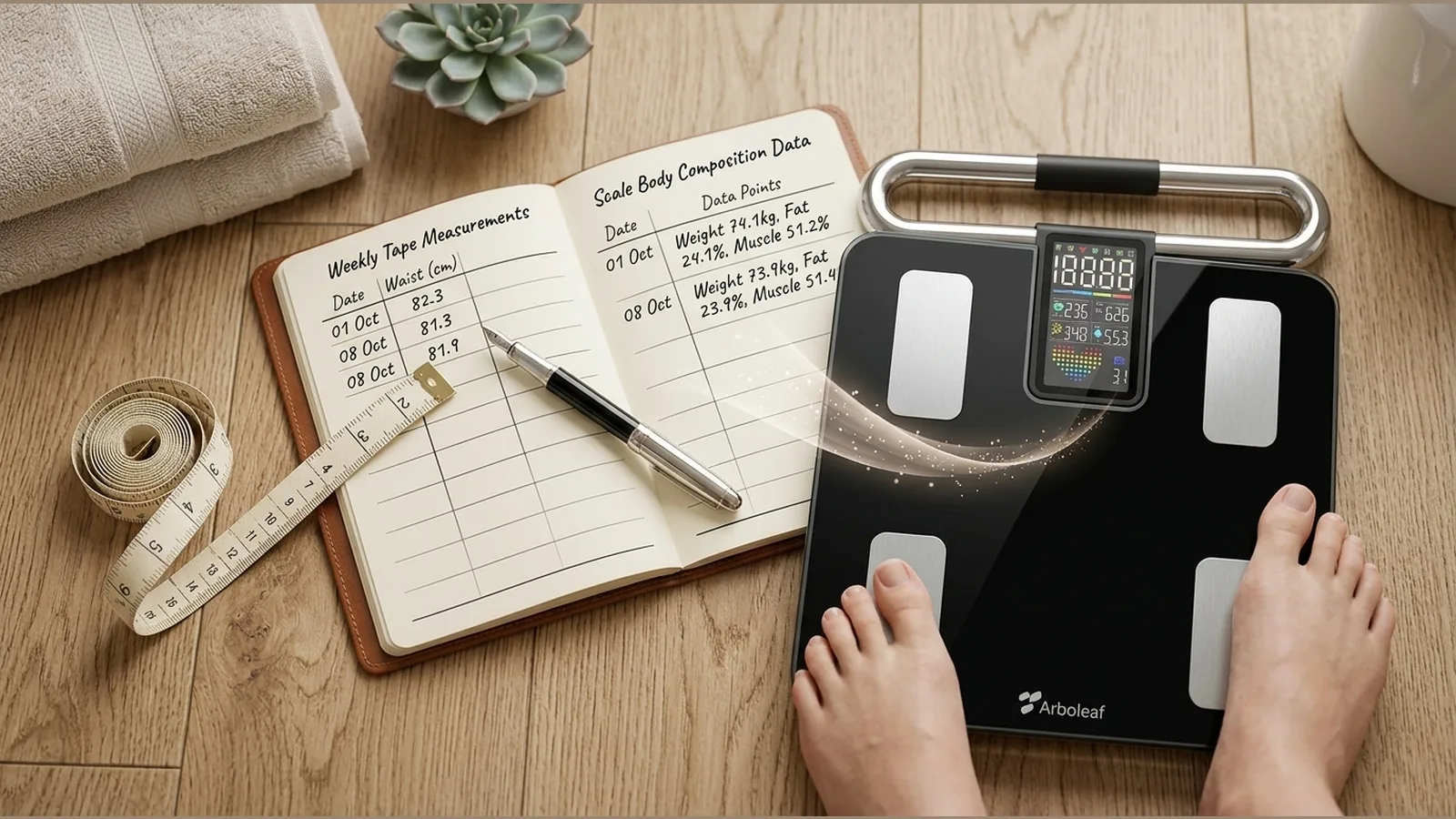
Waist measurement and smart scale together
Using waist measurement and smart scale together means treating them as two separate signals: a tape measure records waist circumference, while a consumer body-composition scale estimates composition from bioelectrical impedance analysis (BIA). Keep the readings side by side, use the same routine each time, and do not fold them into one score or treat either as a medical diagnosis.
Direct comparison
A tape measure answers a simple anthropometric question: how large is the waist at a chosen landmark. A smart scale answers a different question: what does an impedance-based model estimate about body composition at that weigh-in. Large research programmes record these as distinct data types rather than interchangeable substitutes. In UK Biobank documentation, waist circumference sits with anthropometry, while impedance-derived body-composition measures are listed separately.
That separation matters for home tracking. Circumference is a length. BIA outputs are modelled estimates. Comparing them only as “better” or “worse” mixes unlike quantities.
What a tape measure captures
A tape measure captures waist circumference when you place it at a consistent anatomical position, keep the tape level, and avoid pulling it so tight that the soft tissue compresses. It does not estimate fat mass, muscle mass, or visceral fat. It also does not diagnose health risk on its own.
Used calmly, the tape is an external complementary tool: it tracks one physical dimension over time. Note the time of day, whether you have eaten recently, and which landmark you used, so later readings remain comparable.
What BIA estimates
Consumer smart scales that use BIA send a small electrical signal through contact electrodes and apply proprietary algorithms to estimate composition metrics. An eight-electrode design with handheld electrodes is one common consumer form; it still estimates rather than images tissue the way clinical imaging methods do.
Research comparing BIA with dual-energy X-ray absorptiometry (DXA) in UK Biobank data has linked BIA–DXA differences to anthropometric factors, including waist circumference. That finding supports caution: body shape and size can influence how closely impedance estimates align with reference methods. A home scale remains a consumer wellness device, not a diagnostic instrument, and it does not measure waist circumference.
Side-by-side tracking table
Log both methods in parallel without inventing a combined index. A simple table keeps the signals honest.
| Signal | Tool | What you record | What you do not infer |
|---|---|---|---|
| Waist | Tape measure | Circumference at a fixed landmark | Body-fat percentage or medical risk category |
| Mass | Smart scale | Body weight from the platform | Waist size |
| Composition estimates | Smart scale (BIA) | App or on-scale estimates your device reports | Clinical body-composition diagnosis |
| Context | Notes | Time, hydration, food, clothing, landmark | A single “progress score” |
Standardise both methods
Longitudinal body-composition work shows that assessment methods differ in how they track change, and that pre-assessment standardisation helps. At home, the same principle applies to both tools.
- Measure at a similar time of day, ideally under similar hydration and meal conditions.
- Use the same waist landmark and tape tension every time.
- Stand in a comparable posture on the scale, with bare feet on the electrodes if that is how the device is designed to be used.
- Record raw values and notes; avoid adjusting numbers to force agreement.
Standard routines reduce day-to-day noise. They do not turn consumer readings into clinical-grade results.
When numbers disagree
Disagreement is expected. Waist can change while weight is steady, or BIA estimates can shift when circumference barely moves. Hydration, recent exercise, food intake, menstrual cycle, and tape placement all affect one signal more than the other.
When readings diverge, treat the conflict as information about method and context, not as a verdict that one tool “failed.” Use confirmed details a blended score to hide the difference. Avoid applying diagnostic waist or body-fat thresholds from memory without checking current official UK guidance for your situation, and seek clinical advice if you need medical interpretation.
Soft product next step
If you want a consumer body-composition scale to sit alongside a tape measure in a calm routine, review the current product details for the ARBOLEAF eight-electrode smart scale with handheld electrodes, Bluetooth and Wi‑Fi connectivity, and a VA colour display. It is a complementary tracking device, not a waist-measurement tool and not a diagnostic product. Purchases through this shop carry a 12-month warranty; start and claim details follow the site’s warranty terms at purchase.
FAQ
Can I replace waist measurement with a smart scale?
No. A smart scale does not measure waist circumference. Keep the tape for circumference and the scale for weight and BIA estimates.
Should waist and body-composition estimates always move together?
Not necessarily. They describe different things, and research links anthropometry such as waist circumference with how BIA estimates can differ from reference methods. Track both without forcing them to match.
How often should I measure?
Choose a sustainable cadence—often weekly is enough for home review—and keep conditions as consistent as you can. Frequency matters less than a repeatable method.
Is this approach a weight-loss plan?
No. This article is about reading two signals clearly. It does not promise weight loss or health outcomes.