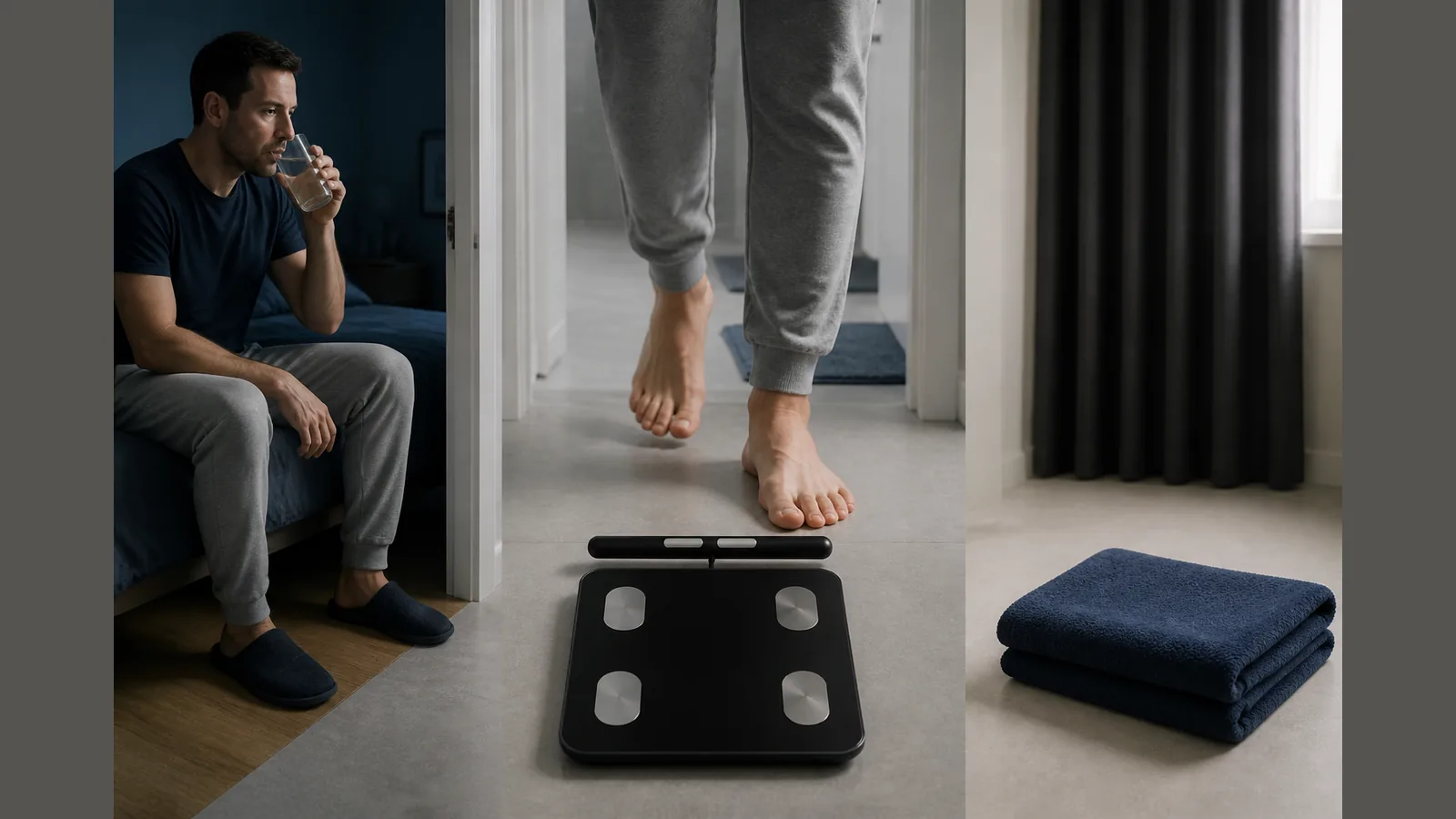
A Smart Scale Routine for Night-Shift Workers: Anchor It to Sleep, Not the Clock
A practical smart scale routine for night shift workers works best when you weigh yourself at a repeatable point in your personal day—typically soon after waking and before food, drink or exercise—rather than at a fixed clock time such as 07:00. Consistency of conditions matters more than matching the calendar day, because body-composition readings from bioelectrical impedance can shift with daily hydration.
Direct answer for rotating schedules
If your shifts rotate, treat “wake-up” as your anchor, not the wall clock. Use the same relative sequence each time you measure: wake, empty your bladder if needed, step on the scale before breakfast or a main meal, and avoid weighing immediately after a long drink or a workout. Comparable readings depend on similar circumstances, including timing relative to food, drink and exercise.
On nights, earlys or days off, keep that same wake-linked sequence. You are building a trend under matching conditions, not chasing a perfect daily timestamp.
Why clock time is a weak anchor
Clock time assumes everyone shares the same overnight fast and daytime activity pattern. Night-shift work breaks that assumption. Water balance changes across a waking period, and guidance on body-fat fluctuation stresses using the same time and conditions because those daily water changes affect bioelectrical impedance analysis (BIA) readings.
Weighing at 07:00 after a night shift is not the same physiological snapshot as weighing at 07:00 after a night of sleep at home. Framing timing as consistency—not as a guarantee of accuracy—keeps expectations realistic when you review week-to-week change.
Choose a repeatable point after waking
Pick one fixed checkpoint in your routine after you wake for the start of your “day”, whether that is evening or morning:
- Soon after waking, before a substantial meal
- Before a large drink or caffeine habit you cannot standardise
- Before exercise, not straight afterwards
- On a hard, flat surface, barefoot, with the same posture each time
Pre-assessment standardisation is important when you interpret change over weeks. A wake-linked checkpoint is easier to repeat across rotating rosters than a clock-based rule that only fits day shifts.
Meal drink and exercise checks
Before you step on the scale, run a short checklist so each reading sits in a similar context:
- Have you had a full meal or large snack in the past few hours? If yes, note it or postpone the weigh-in to your next wake cycle.
- Have you just drunk a large volume of fluid? Hydration swings can move BIA-based composition estimates even when fat mass has not changed.
- Have you exercised hard just before measuring? Sweat loss and fluid shifts make the session harder to compare.
- Are bare feet and hand contact (if your scale uses handheld electrodes) dry and consistent with previous sessions?
These checks are about matching circumstances, not about diagnosing health or sleep problems.
Two-week template
Use a simple fortnight plan so rotating shifts do not erase the habit:
- Week 1: Weigh only on waking for your first work block of the week and once on a day off, using the same checklist. Record shift type (night, early, rest) beside the reading.
- Week 2: Repeat the same wake-linked slots. Compare like with like—night-shift wake readings with other night-shift wake readings—rather than every calendar date in one line.
- Optional note: If a reading fails the meal, drink or exercise checks, skip it and wait for the next clean wake cycle.
Two weeks is long enough to practise the routine and short enough to adjust the checkpoint if your roster makes it awkward. Do not expect the scale to detect shift patterns or send reminders; the template is yours to keep.
When a missed reading does not matter
Missing a day—or several—does not break the method. Longitudinal tracking is more useful when remaining measurements share standardised conditions. A gap is preferable to a rushed weigh-in after a meal, a long drink or a workout that you would not normally include.
If you miss your usual wake slot, wait for the next comparable wake rather than forcing a clock-time catch-up. One clean reading beats three mismatched ones when you later look at direction of change.
Soft product next step
If you want hardware that fits a routine-based approach, a connected body-composition scale can sit beside the same wake-linked habit without needing unverified app features such as shift detection, reminders or scheduling. The black Arboleaf eight-electrode model with handheld electrodes, Bluetooth and Wi‑Fi connectivity, and a VA colour display is built for home use as part of a steady checklist, and purchases through this shop carry a 12-month warranty.
For current specifications and ordering details, see the Arboleaf connected body-composition scale product page.
FAQ
Is there a best time to weigh on night shift?
The most workable “best time” is soon after you wake for that shift cycle, before food, large drinks and exercise—not a fixed hour on the clock.
How does body composition tracking work with shift work?
Compare readings taken under similar wake, meal and activity conditions. Group night-shift wake readings together when you review trends, instead of mixing them with day-off morning readings without noting the difference.
What makes a consistent weigh-in routine for shift workers?
A short, repeatable sequence after waking, a simple meal–drink–exercise checklist, and permission to skip messy sessions rather than force a clock-time weigh-in.
Will a smart scale fix irregular sleep?
No. A scale supports body-composition tracking under consistent conditions. It is not sleep advice or occupational-health guidance.