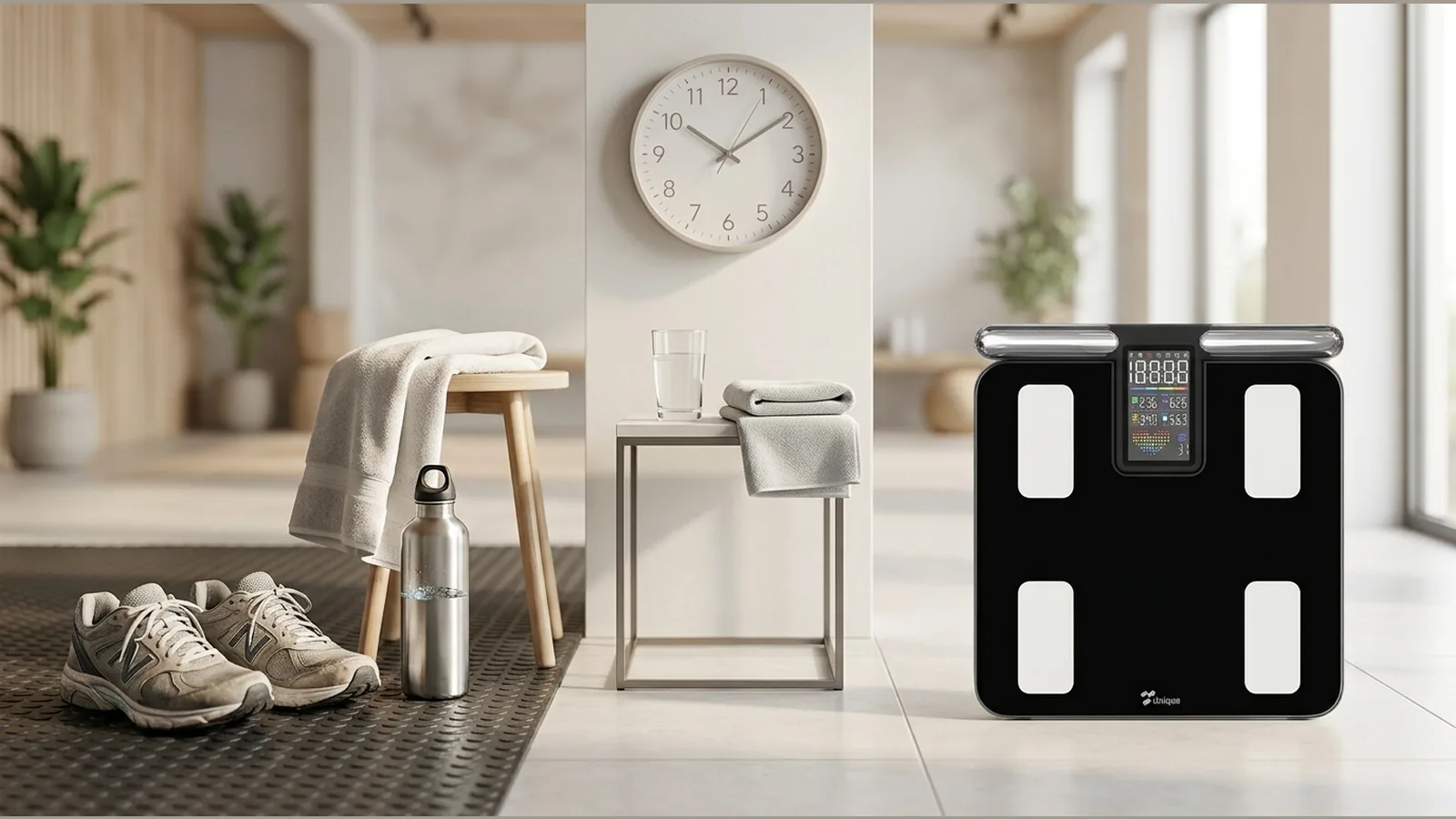
Smart scale measurement after exercise: wait, Standardise, Then Compare
Direct answer
For reliable smart scale measurement after exercise, wait until you are no longer immediately post-workout, then measure under the same conditions every time and compare trends rather than a single reading. Exercise and short-term hydration shifts can change bioelectrical impedance (BIA) results, so an after-gym weighing is a poor basis for judging body-composition change.
Why exercise changes measurement conditions
Many home smart scales estimate body composition with BIA. That method is sensitive to how hydrated you are and to other short-term state changes. Manufacturer guidance on body-composition monitoring advises avoiding measurements straight after exercise and keeping conditions consistent so readings are more comparable over time.
Support guidance also notes that hydration changes can alter body-fat percentage readings and that repeatable conditions matter if you want readings you can trust side by side. A controlled study has likewise found that unstandardised pre-assessment conditions can blunt or exaggerate apparent changes, which is why “same time, same routine” matters more than chasing one dramatic post-workout number.
Pre-measurement decision ladder
Use this simple ladder before you step on a smart scale after training:
- Are you still warm, sweaty, or freshly finished? Postpone body-composition measurement. Do not treat a universal “wait X minutes” rule as medical advice; choose a calm, settled state you can repeat.
- Is this a weight-only check or a composition check? Body weight can still fluctuate with fluid loss; composition estimates are especially sensitive to hydration and timing.
- Can you match your usual routine? Same time of day, similar clothing, empty pockets, and the same standing or hand-contact habit if your scale uses hand and foot electrodes.
- Is the floor stable and the scale on a hard, level surface? Incomplete contact or an uneven surface undermines a repeatable contact routine.
Same-condition comparison routine
Build one routine and stick to it:
- Pick a regular window (for example mornings before food and drink, or another fixed daily slot you can keep).
- Avoid measuring immediately after hard training, saunas, or large fluid shifts when you care about composition trends.
- Stand the same way each time; if the scale has hand-held electrodes as well as foot pads, use the same grip and posture so contact is consistent.
- Compare like with like: today’s reading against other readings taken under matching conditions, not against a sweaty post-session snapshot.
The aim is not to prove a workout “worked” on the spot. The aim is a fair before-and-after series under matched conditions.
What to record
Alongside the scale reading, note a few context fields so later comparisons stay honest:
- Date and time of day
- Whether the reading was soon after exercise or after a settled period
- Rough hydration notes (for example, unusually thirsty or after a long session)
- Clothing and whether you used hand electrodes that day
- Anything unusual (illness, travel, late meal) that could explain a one-off swing
You do not need a clinical log—just enough detail to decide whether two readings belong in the same comparison set.
When to ignore a one-off result
Ignore or quarantine a single result when:
- It was taken straight after exercise or in clearly different hydration conditions
- Contact felt incomplete (hands or feet not firmly on the electrodes)
- It clashes sharply with several same-condition readings around it
Unstandardised conditions can make change look smaller or larger than it really is. One odd reading is a prompt to re-measure under your usual routine, not proof of sudden progress or setback.
Soft product next step
If you want a home routine built around consistent contact—including hand and foot electrodes on a black eight-electrode smart scale with connectivity options—review the current Arboleaf smart scale product details. Use it for repeatable home tracking under matched conditions; it is not a clinical device and should not be treated as a direct measure of workout progress. Purchases from this storefront carry a 12-month warranty; coverage start date and claim process details should be checked at purchase.
See the Arboleaf product page when you are ready to set up a same-condition measurement habit.
FAQ
When should I weigh after a workout?
For body weight alone, waiting until you have cooled down and dried off reduces some fluid-related noise, but short-term water loss can still move the number. For BIA body-composition estimates, wait until you are no longer immediately post-exercise and prefer your usual standardised window.
Why does BIA after exercise look different?
Hydration and other short-term state changes can alter BIA readings. That is why guidance emphasises repeatable conditions rather than interpreting a single post-workout composition figure.
How do I use a body fat scale post workout without misleading myself?
Either skip composition measurement until your settled routine, or clearly label the reading as post-exercise so you do not compare it with resting baseline days. Trends from matched conditions are more useful than any one after-gym result.