what is fat free mass on a smart scale
Fat-free mass on a smart scale is an estimate of everything in your body that is not fat tissue—typically including muscle, bone, organs and body water—derived from bioelectrical impedance analysis (BIA) rather than a direct laboratory measurement. Treat the reading as an educational trend marker under consistent conditions, not a diagnosis or a personal substitute for clinical imaging.
Define fat-free mass directly
In plain terms, fat-free mass (sometimes discussed alongside lean mass) is the non-fat compartment of body composition. A consumer smart scale does not weigh that compartment separately; it estimates it from an electrical signal through the body and a proprietary model. Research infrastructures such as UK Biobank record impedance-derived fat-free mass separately from manual anthropometry and predicted muscle measures, which underlines that fat-free mass and muscle-related outputs are not the same field.
Explain how BIA estimates compartments
BIA sends a small current between electrodes and uses the resulting impedance, together with details such as height, age and sex where the device asks for them, to estimate how much of your weight sits in fat versus non-fat compartments. Population studies comparing BIA with dual-energy X-ray absorptiometry (DXA) have shown strong population-level correlation between BIA and DXA, while individual-level differences remained. In other words, group agreement does not mean your single smart-scale reading matches a DXA result for you personally.
Compare fat-free mass and muscle mass
Fat-free mass is broader than muscle mass. Muscle is one part of the fat-free compartment; bone mineral, organs and water also contribute. Labels on apps or research datasets may list fat-free mass, lean mass and muscle-related predictions as separate concepts. If your scale or companion software shows more than one of these, do not assume they are interchangeable, and do not assume every metric is available on every firmware or display until you have checked the device you own.
Show a repeatable review checklist
Longitudinal interpretation is sensitive to how you prepare before each weigh-in, and results differ by method. A British Journal of Nutrition comparison notes that tracking changes in body composition depends on pre-assessment standardisation and on the method used. For a home checklist you can repeat:
- Weigh at a similar time of day, ideally under similar hydration and meal timing.
- Use the same surface, bare feet, and the same user profile details the scale expects.
- Avoid comparing a rushed morning reading with a late-evening reading after heavy exercise or a large drink.
- Record the fat-free mass estimate alongside scale weight so you review trends, not single spikes.
- Change only one routine variable at a time when you deliberately test consistency.
Explain limits and clinical escalation
This article is educational only and does not diagnose health status. Consumer BIA is not equivalent to DXA for an individual person. Smart-scale estimates can move with hydration, recent food or drink, skin contact, electrode contact quality and algorithm assumptions. Do not treat them as clinical judgements, accuracy guarantees or a fixed catalogue of health metrics. Speak to a qualified clinician if you need body-composition assessment for medical decisions, unexplained weight change, oedema, or advice about eating, training or illness.
Soft product next step
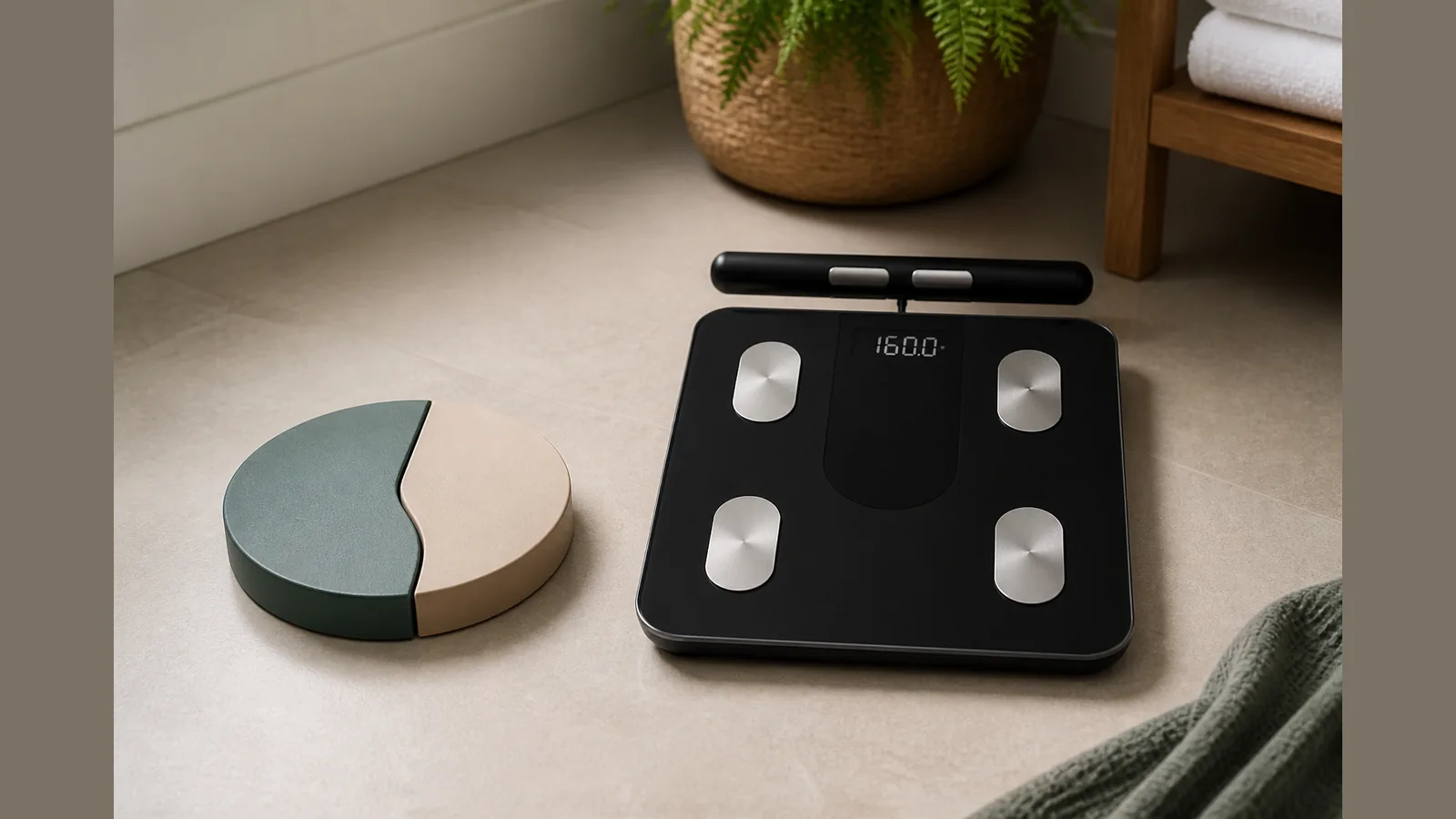
If you want hardware built around multi-electrode BIA at home, an eight-electrode, handle-equipped smart body-composition scale provides foot and hand electrodes rather than foot-only contact. One example on this site is a black, handle-equipped eight-electrode model with Bluetooth and Wi-Fi connectivity, a VA colour display, a tempered-glass top and ABS base, and a 12-month warranty on products sold here. Availability of any named metric in the app or on-screen readout depends on firmware and configuration, so confirm what your unit actually reports. For current specifications and offers, see the current Arboleaf smart scale product details.
FAQ
Is fat-free mass the same as muscle?
No. Muscle is part of fat-free mass, but fat-free mass also includes other non-fat tissues and water. Treat muscle-related labels and fat-free mass as related but distinct estimates when both appear.
Why does the number change day to day?
BIA estimates respond to hydration, timing, contact and routine. Standardising those factors makes trends more readable; method differences still apply when you compare devices or clinic tests.
Can a smart scale replace a clinical scan?
No. Population correlation between BIA and DXA does not remove individual-level differences. Use home readings for education and habit tracking, and escalate to clinical care when decisions about health are required.