Body composition scale for strength training beginners: features and limits
A body composition scale for strength training beginners is most useful as a home trend tracker when you weigh under the same conditions each time, treat estimates as directional rather than diagnostic, and pair readings with your training log—not as a tool that can prove muscle gain over a short period or prescribe your programme.
Direct buyer fit
If you have started a strength programme and want a clearer picture than body weight alone, a consumer smart scale can help you watch how mass estimates move alongside progressive overload, sleep and nutrition. It suits beginners who value repeatable home checks more than clinic-grade body-composition imaging. It is a poor fit if you need medical diagnosis, individual clinical accuracy against reference methods, or marketing claims such as fixed metric counts or verified health-platform integrations that have not been independently confirmed.
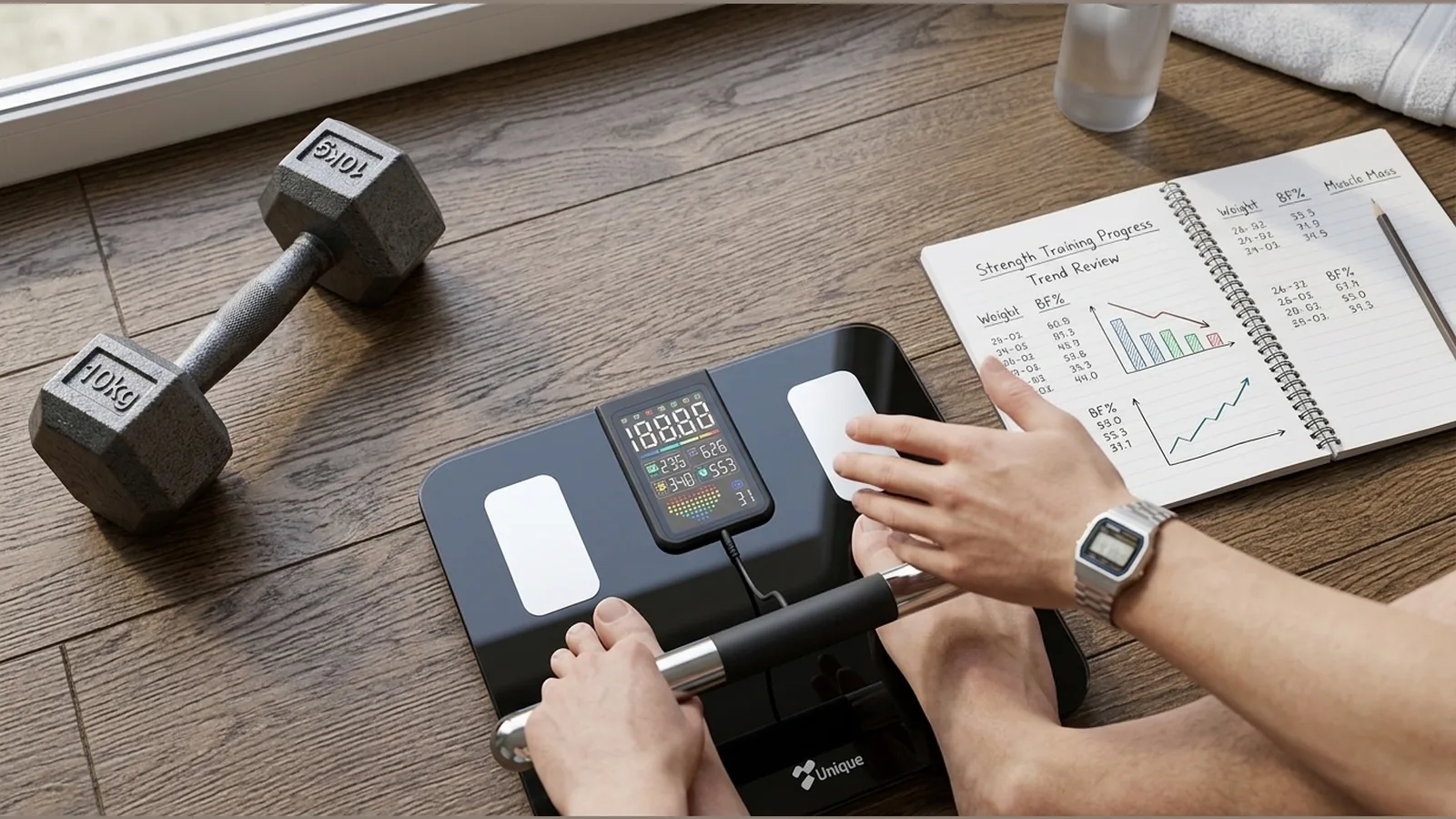
For shoppers comparing hardware form factors, look for features that support consistent stance and data capture—such as a handle with an eight-electrode structure, Bluetooth and Wi-Fi connectivity, and a colour VA display—without treating those features as proof of medical accuracy.
What a consumer scale can track
Consumer bioelectrical impedance analysis (BIA) scales typically estimate body weight and derived composition figures from how a small current travels through the body. Those figures can be handy for spotting broad direction of travel while you build strength, but they are not a training prescription and should not be used to diagnose health conditions.
- Weight under a stable routine is usually the most straightforward home signal.
- Composition estimates may change with hydration, recent food, and how you stand—so week-to-week noise is expected.
- App charts are for personal trend-watching; they do not replace coaching or clinical advice.
Why repeatable conditions matter
Research on tracking body-composition changes in resistance-trained participants shows that longitudinal estimates are sensitive to how you standardise conditions before each assessment. In practice, that means fixing the variables you can control so changes in the chart are easier to interpret.
Practical guidance on measuring and monitoring body composition stresses consistent timing, placing the scale on a hard floor, standing barefoot with solid contact, and avoiding measurement immediately after exercise. Keep notes on sleep, training load and last meal so a single odd reading does not drive programme changes.
Handle electrodes and posture
Scales that add hand-held electrodes aim to involve more of the body in the measurement path than foot-only designs. For beginners, the useful habit is posture discipline: same stance, arms and grip as the manufacturer describes, quiet standing, and no rushed weigh-ins after a session.
An eight-electrode layout with a handle can make that routine easier to repeat, but it still does not turn a consumer device into a clinical instrument. Follow the product instructions for contact and placement rather than inventing your own ritual for higher accuracy.
Six-week review checklist
Use a fixed review window so you judge trends, not day-to-day noise. A simple six-week checklist for strength-training beginners:
- Weigh on the same days and time of day, ideally before training and under similar hydration and meal timing.
- Record scale weight and any composition estimates alongside sets, reps and how sessions felt.
- Flag outliers that followed late nights, heavy meals, travel or hard conditioning blocks.
- Review the six-week direction with your programme goals—strength, technique and recovery first—before changing diet or training volume based on a single estimate.
- Do not treat short-term estimate shifts as confirmed muscle gain or loss.
When other methods add context
A large UK Biobank comparison of BIA and DXA body-composition measures found population-level utility while also showing individual differences from dual-energy X-ray absorptiometry. That is a reminder to treat home BIA as one lens, not a gold-standard personal verdict.
Tape measurements, progress photos under consistent lighting, and strength numbers on key lifts often add useful context when a home chart looks flat or noisy. Clinic or laboratory methods may be appropriate when a clinician requests them; they are not required for every beginner who simply wants steadier home weighing habits.
Who should not upgrade
Skip or postpone a smart-scale upgrade if you are likely to chase daily composition numbers, if a clinician has advised against consumer BIA for your situation, or if you mainly need a simple, reliable weight reading and already have one. Also hold off if you expected medical-grade accuracy, competitor rankings, or guarantees that a scale will detect muscle gain across a short block of training—those expectations sit outside what consumer BIA can responsibly claim.
Soft product next step
If a handle-equipped, eight-electrode smart scale with Bluetooth and Wi-Fi and a colour VA display matches how you want to log home trends, review the current product details for the black model sold on this site, including the stated 12-month warranty. Use that page to confirm setup expectations before you buy; treat app platforms, health-sync claims and any fixed metric counts as items to verify in the listing and instructions rather than as proven performance.
FAQ
Can a body composition scale for strength training beginners prove I am gaining muscle?
No. Consumer BIA estimates can move for many reasons, including fluid balance. Track strength and training consistency first, and treat composition charts as directional only over longer, well-standardised periods.
How often should I weigh during a strength programme?
Most beginners do better with a small set of scheduled weigh-ins each week under matched conditions than with multiple daily checks. Consistency beats frequency.
Do handle electrodes make the reading a diagnosis?
No. Extra electrodes may support a fuller impedance path and a steadier home routine, but the device remains a consumer monitor, not a diagnostic or prescribing tool.
What should I check on the product page before buying?
Confirm the handle and eight-electrode design, wireless options, display type, warranty length and any app requirements. Avoid relying on unverified claims about metric totals, unlimited users, medical accuracy or platform integrations.