Smart Manufacturing Technology Ltd - Complete UK Guide
8-Electrode vs 4-Electrode Body Fat Scales, What the Extra Electrodes Actually Do
Foot-only scales measure half your body and estimate the rest. Here is what 8-electrode segmental measurement changes, backed by published error margins.
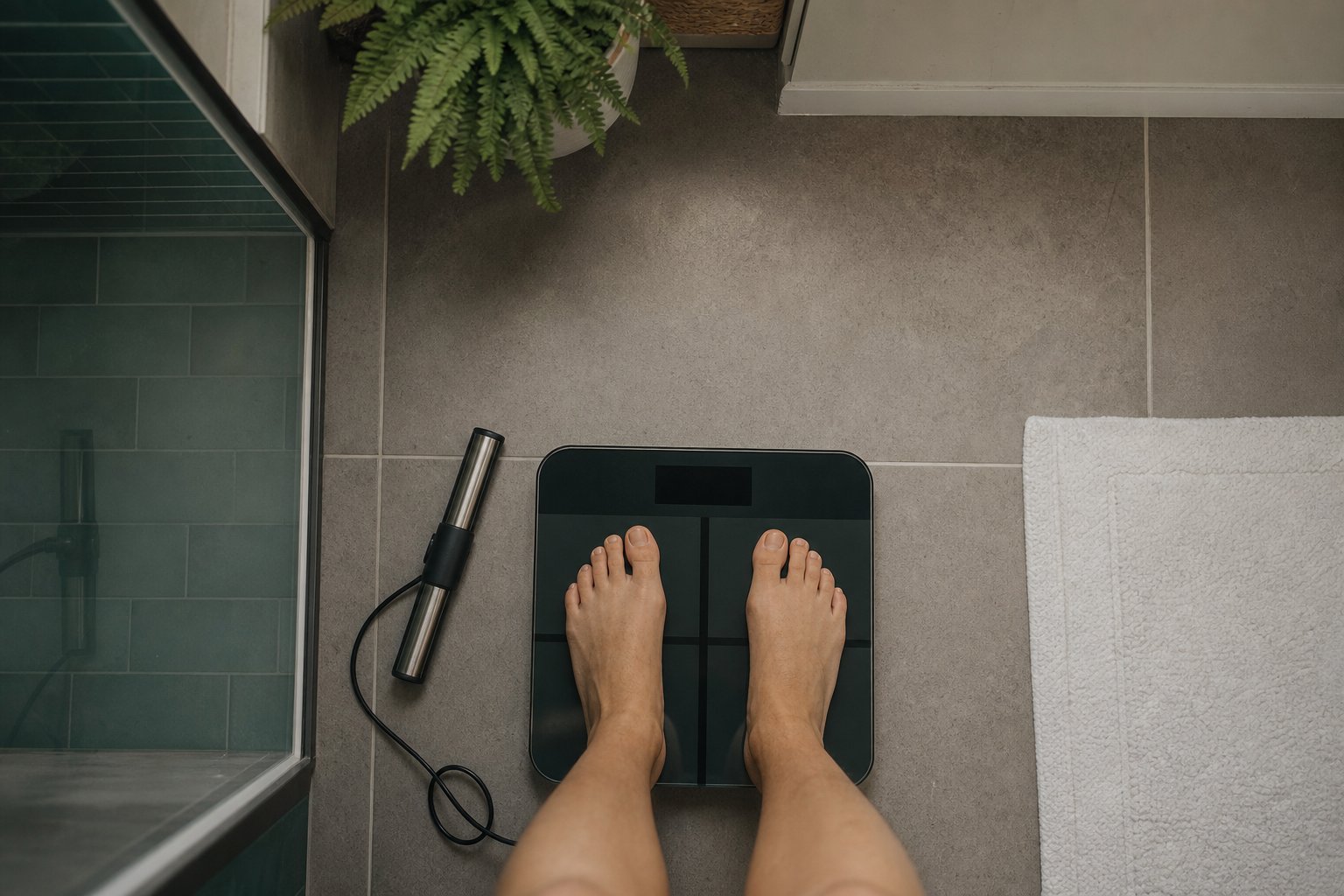
A 4-electrode scale sends current up one leg and down the other, so it directly measures only your lower body and estimates everything above the hips. An 8-electrode scale adds a hand-held sensor bar, routing current through arms, trunk and legs separately. Published error bands narrow from roughly 4-8 points to 3-5 points versus clinical reference methods.
The physics in one paragraph
Bioelectrical impedance analysis works by measuring how easily a small current travels through your tissues. The catch is geometry: current follows the path you give it. Four electrodes under your feet create a circuit that runs up one leg, across the pelvis and down the other leg. Your torso — where visceral fat lives — and both arms are largely outside the measured path. The scale fills that gap with assumptions drawn from population averages: it assumes your upper body carries fat and muscle in a typical proportion to your legs.
Eight electrodes change the geometry. Four remain under your feet; four more sit in a handle you hold during measurement. The device can now run current hand-to-hand, hand-to-foot, and foot-to-foot, isolating five body segments: each arm, each leg, and the trunk. Nothing above the hips needs to be assumed any more — it is measured.
Why foot-only readings drift for real bodies
Population assumptions work tolerably if you are built like the population average. Most of us are not, and the further you sit from that average, the more a 4-electrode estimate wobbles:
- You train upper body seriously. Foot-only current never sees your shoulders. Gain five kilograms of upper-body muscle and a 4-electrode scale infers most of it from a formula rather than measuring it.
- You carry weight centrally. Trunk fat is the region foot-only measurement handles worst, precisely because the current path skirts the abdomen.
- You are petite or very tall. Height enters the equation as a strong prior. At the extremes, the standard equations are calibrated on thin data.
- You are losing fat and gaining muscle at once. Change happens segment by segment. A whole-body estimate built on leg impedance smears those segmental shifts into one blurry number.
This is not a claim that 8-electrode scales are perfectly accurate — no home BIA device is, and we lay the full error picture out in our honest accuracy guide. The claim, supported by the published literature, is narrower and more useful: hand-plus-foot measurement removes the largest single source of guesswork and behaves more consistently across different body shapes.
What segmental data looks like in practice
The Arboleaf 8-electrode scale uses the dual-frequency, hand-and-foot architecture: a magnetic detachable handle stores on the platform, and measurement runs at two frequencies (a low frequency around 20 kHz and a high frequency around 100 kHz). Lower frequencies travel mainly around cells; higher frequencies pass through cell membranes. Reading both gives the algorithm a better estimate of the split between water inside and outside your cells — one more assumption replaced by a measurement.
The practical output is a segmental report in the app: muscle and fat estimates for left arm, right arm, left leg, right leg and trunk, alongside the whole-body figures. Three things become visible that a single number hides:
- Where change happens. Twelve weeks of strength work might show arm muscle rising while trunk fat falls — invisible in a whole-body percentage that barely moves.
- Left-right imbalance. Rehabilitation after injury, or simply a dominant side, shows up as a persistent asymmetry you can actually watch converge.
- Trend quality. Segment trends that agree with each other are strong evidence of real change; a whole-body blip with flat segments is usually noise.
The honest counter-argument
Browse the smart-scale forums and you will find experienced users who argue the handle is not worth the faff — that it makes each weigh-in slower and the extra data does not change what they do. For a pure weight-tracker, that is fair. If all you want is a reliable weight trend, a good 4-electrode scale delivers it for less money, and we say so plainly in our comparison pages.
There is also a consistency argument on the other side: one German consumer-magazine test ranked a well-known foot-only model poorly for accuracy, while community DEXA comparisons have found some budget 8-electrode models inconsistent between readings. Electrode count is an architecture advantage, not a guarantee — sensor quality and algorithm still decide how repeatable a specific scale is. For repeatability figures specific to this model, we are running our own bench protocol — ten consecutive same-person weigh-ins under fixed conditions, method published in full — and the standard deviation goes up only when it comes off that bench, never from an estimate.
Our position: if you only care about weight, buy cheap. If you care about composition — where the fat is, whether muscle is growing, whether your recomposition is working — the segmental architecture is the difference between measuring and guessing, and it is why this product exists at its price point rather than at £25.
Choosing between the two, quickly
A 4-electrode scale fits you if: you want a dependable weight trend, you weigh under consistent conditions, and body fat percentage is a curiosity rather than a decision input. Spend the savings on food quality.
An 8-electrode scale fits you if: you strength train, you are deliberately recomposing, your build differs from average, or you have been burned by a foot-only scale reading that made no sense. The segmental report is also simply more interesting data if you are the kind of person who exports their numbers — which, if you are, our data features page covers CSV export and app sync in detail.
Either way, the rules from our accuracy guide still apply: same time, bare feet, hard floor, judge the month not the morning. Architecture buys you a narrower error band and segment-level visibility; consistency is still something you supply yourself. And if you want to see exactly how the 8-electrode design stacks up against the £179 alternative with the same architecture, our Withings comparison puts the two side by side, price included.
Ready to try ARBOLEAF?
Shop Now — £119.34